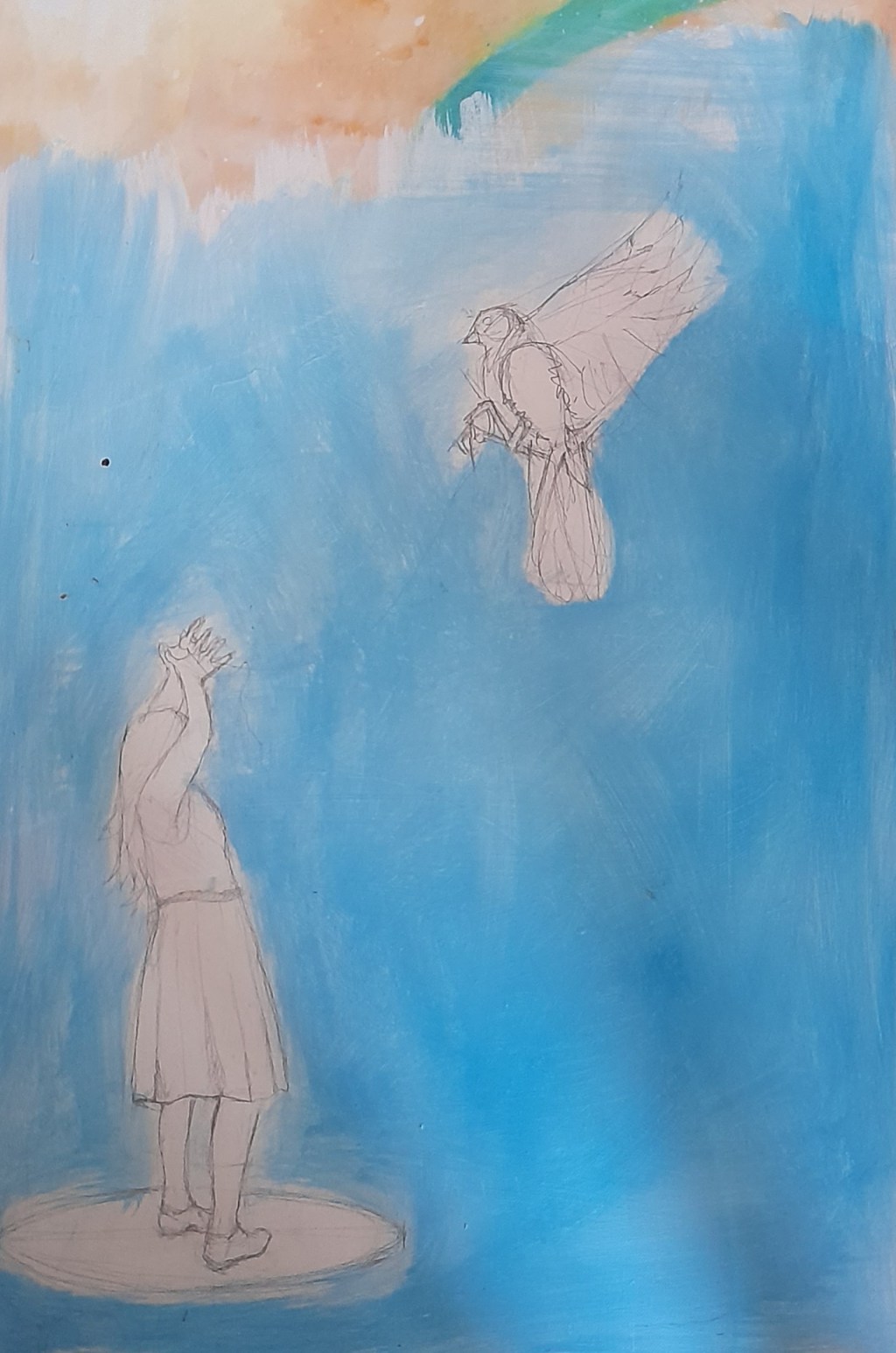
Still – a working painting in progress- Carrie Creamer
Still here thinking about memory!—its fluidity, its layers, and its ability to carry both the beauty and the burden and pain of life. I do wonder sometimes though if maybe the stories we tell ourselves and others are never fixed; they shift within all of us as we grow and understand each layer to a greater or lesser extent.
In life, I’ve found that the squeaky wheel is always fixed first so to speak. It’s easy for a story to be rewritten, for a narrative to be reshaped to serve the teller. Does memory have truth then? Plato likened memory to an engraved wax tablets that could be erased easily and used again. So, is it true that memory has always been elusive, a concept shaped as much by metaphor as by understanding. In an article for The New Yorker, Michael Specter suggested that memory was erasable, reusable and fleeting. He points out that memory is not static. Each recollection is not simply retrieved but actively reconstructed, a fragile chain of chemical interactions which are subject to the erosion of time and the overlay of new experiences and ways of telling. A shifting of the original.
So if memory and its ever swiftly ways, adaptations and reshaping and retelling exits then yes nothing is fixed. I have certainly reflected on memories of the past and definitely the present and shifted my beliefs, maybe even at time softened my memory or indeed judgement. If that is all possible then we know that the stories people tell about themselves, or about us, are never fixed or true. Like those ancient wax tablets, they can be re-etched with each retelling, sometimes deepening grooves, sometimes overwriting them entirely. Elizabeth Loftus, a leading expert on memory carried out something called The false memory experiment which in turn questioned our understanding of memory’s flexibility if you like and the reliability of eyewitness testimony. Her research dug deep into how easily memories can be distorted or fabricated through suggestive influences. This is turn challenged the idea of memory as a perfect recorder of events. Imagine that! I mean, in storytelling, the story often evolves and moves in each retelling. Of course there are static moments of truth so to speak but the story becomes a little more breathable and moveable in each telling. Indeed Marcel Proust said: “Remembrance of things past is not necessarily the remembrance of things as they were.”
In my work, I find repeatedly drawn to this idea between permanence and impermanence, between what we hold onto and what we let fade. Memory then is always a reflection of who we are. To weave and over weave moments and stories.
I think of these truths or memories as delicate threads, fragile but enduring. They weave through my work, and the notion of the beauty of care and kindness—the gentle defiance of holding onto light in a world where shadows often try to claim the stage. Yet, I am haunted by the question: what on earth is the truth anymore? We live in a time where words, once spoken, are treated as unshakable fact, no matter how layered or distorted they may be. The permanence of such narratives, their inability to be undone sometimes weighs heavily on me. The ripples they create carry an emotional weight far beyond their origin, a chain reaction of unease, guilt, and uncertainty. These are not the ripples of clarity, but of manipulation—designed to leave those in their wake questioning their own sense of stability and truth.
And yet, I return to the thought: Let them. Let them cast their stones; let them whisper their tales. This refrain, drawn from the new bestseller by Mel Robbins- Let them theory is an interesting one. It certainly takes time to lean into that idea of let them but I guess it’s as much about trying to keep you rooted in your own truth. Stand aside and let them.
A Lesson in Love and Boundaries
Perhaps the greatest lesson for me this year as I look ahead…(It’s my birthday in January. I am no fan of the month of January but I am trying to bring January back so to speak- to make it popular and loved- it’s a hard task) is the idea of when to embrace and when to release, when to stand firm and when to let go.
There is definitely a kind of heartbreak in choosing and firming boundaries, in saying no to the things that drain us. However, in setting boundaries, we make space for what truly matters: the people and passions that nurture rather than deplete us. Sometimes what appeared to be loss was, in fact, liberation.
I think of this now, watching the slow passage of time in those I hold dear. There is a lesson here about care—how we tend to the living with love. The quiet acts of love: a warm hand, a whispered word, a presence that says, I am here. These moments, small and sacred, remind us that the end is not a thing to be feared but a return to the infinite. In these moments, I think of memory as like water, carrying fragments of both light and shadow. We cannot control its flow, but we can choose how to stand beside it. Our light and our dark.
 Carrie Creamer
One response to “Memory and the Shape of Truth”
Thought provoking, well written , good work,
LikeLike