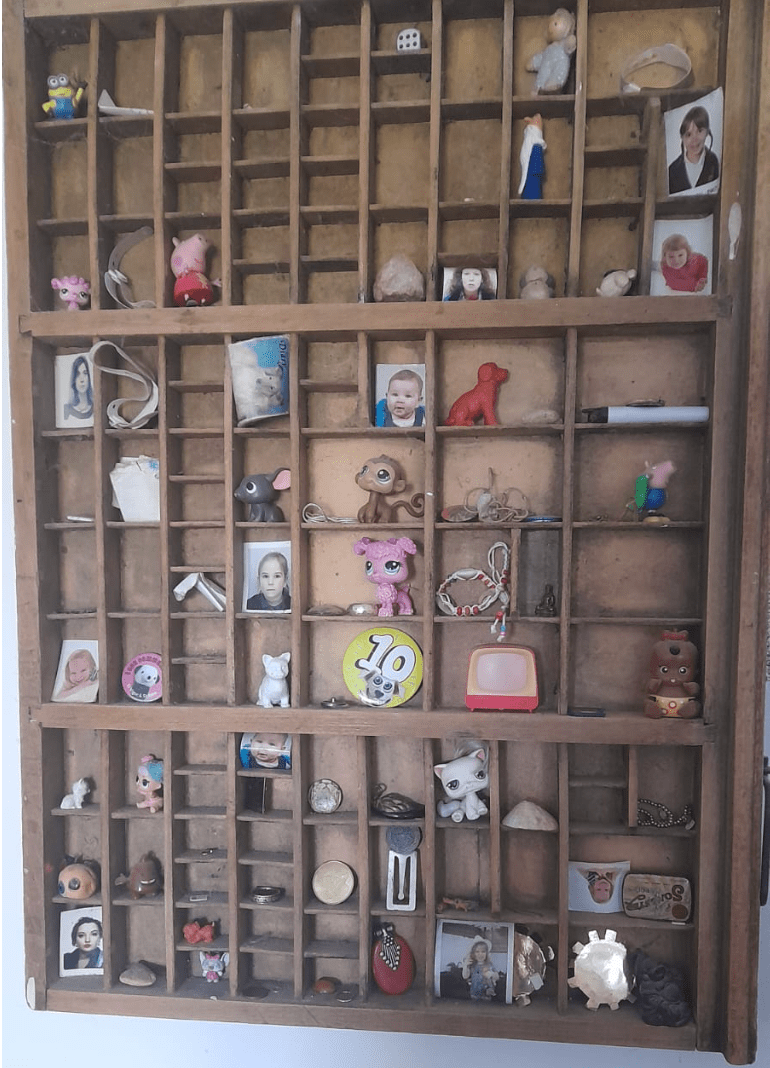
In my living room, I have an old printing press drawer hanging on the wall. The tiny box shelves are damaged with dents and some veiled in cobwebs. I keep an assortment of things on each shelf; a tiny baby toy from a Wendy house; a selection of passport photos from different people; a windup toy; an old love letter; a clay model; several badges; a baby tooth; some rocks from day trips; and two little swan shaped coat hooks from my grandmothers gilet. It is my memory corner. My own silent storage of lost times and memories.
I guess it’s my own archive, markers of loss and love, objects that witness experiences. Each of them hold stories, both personal and collective. You do reach a certain age where casting your mind to the past is something of a regular bedfellow but lately I have found myself landing more often on objects.
Considering two projects that I am working on—“Grief’s Broken Brow” (archives and memory) and “Creative Conversations” (conversation with cherished objects and other things) there is an opportunity to explore how objects carry personal, cultural, and historical significance.
I’m reminded of Joseph Cornell and his boxes which featured found objects of intimate other worlds. Elements of memory broken up with grief and memory. One of my all time favourite artists has always been Christian Boltanski, whose work looks at lost lives, objects, clothing, photographs. A great sense of loss, grief and yearning.
It would be absolutely true to say that much of my work does and has always centred on memory with a fascination on objects and memory.
I’ve been reading and researching people like Maurice Halbwachs who developed the theory of “collective memory,” arguing that our memories are shaped by the social contexts in which we live as well as Pierre Nora and Roland Barthes’ Camera Lucida. I have also fished out my old copy of the poetics of space which explores how we experience intimate spaces, such as houses, rooms, and corners, through memory, imagination, and emotion.
The other day when I was listening to the radio, there was a curious call out for a missing relic from The Ploughing Championships of all places. It was a lock of hair from the late Carlos Acutis which was kept in a small black relic box. In the 1800’s it was quite common practice to incorporate hair with some form of jewellery. You could literally grind down hair to mix it with paint to make miniature paintings. For those that could afford it, a photographer was also invited to the home after someone had died to take their photograph. It was a way to preserve their memory through imagery. You could be photographed with trinkets and loved items.
It’s not uncommon to add something to the coffin of your loved one as keepsake, to support and comfort them as they move onto their journey. Of course the Egyptians were probably one of the most famous for being bored with objects to ensure a safe transition to the afterlife. But the vikings did it too. You could be buried with things you owned as well as weapons or even your horse. The Chinese have Terracotta armies, the Aztecs had gold and pottery buried with loved ones.
So, objects and objects of affection are important. Psychologists studying trauma and memory often discuss how physical objects help individuals process grief and trauma. Objects like photos or personal belongings can serve as tools for constructing narrative memory.
So, here I am. About to embark on a study on memory, loss and stories, history and more. I am not the first and certainly will not be the last person to look at this area. Ireland has a long rich history of artists, writers and poets exploring memory, loss and objects. I am simply adding my name to the list. I guess we can all cast our eye around the room for an object that holds a story, something important to us. It might be our story or shared one passed down to us.
As we begin the first series of creative conversations, we have chosen to explore objects that are important to us. It is already fascinating to discuss the possibilities. Each person bringing something to the table that is important to them, from a teapot to family jewellery, I am always in awe of what and how people share at this moment. The importance of listening and taking in what someone wants to tell you and why. It’s not always clear and to be honest, sometimes the objects chosen may seem insignificant but they always have purpose and there is ALWAYS a story to be told and a story to be heard. This will be the moment to acknowledge that and record and receive it.
 Carrie Creamer